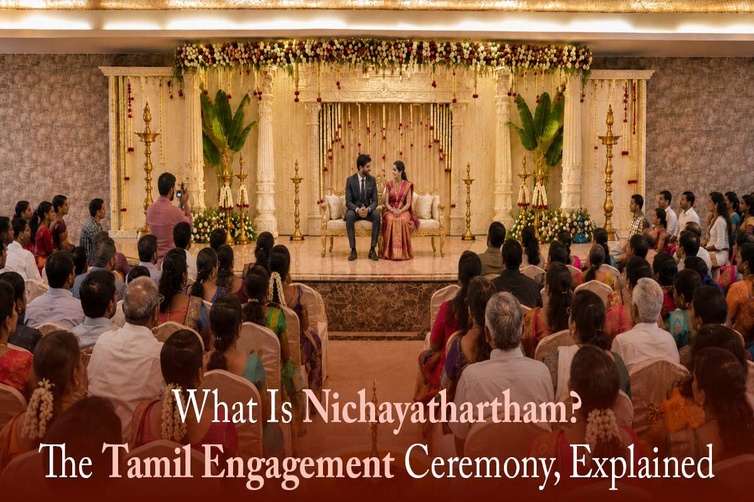
If you’ve been invited to a Nichayathartham and aren’t sure what to expect, here’s the short version: it’s the Tamil Hindu engagement ceremony where two families formally agree to a marriage, in front of relatives and elders, built around a ring exchange and a written agreement. If you’re planning one at one of the Marriage Halls in Kovilambakkam, most of what follows will look familiar, since the ritual sequence stays fairly consistent across Tamil Brahmin families around Chennai.
What does Nichayathartham mean?
Nichayathartham comes from a word that roughly translates to “promise” or “commitment,” and that’s exactly what the ceremony is: the formal point where the bride and groom agree to marry, with both families present to witness and consent.
It sits early in the Tamil wedding sequence, usually well before the wedding itself. You’ll also hear it called Nischitartham in some South Indian communities, and Vaang Nichayam among certain Tamil Brahmin families. People mostly use these terms interchangeably to mean the same event.
Is Nichayathartham just an engagement?
Functionally, yes. If someone outside the community asks what Nichayathartham is, “engagement” is the closest one-word answer. What sets it apart is the ritual detail, particularly the written agreement letter (more on that below), which gives the ceremony a bit more formal weight than a typical engagement announcement.
Where it gets slightly confusing is terminology. Nischitartham is the broader South Indian term; Nichayathartham and Vaang Nichayam tend to be used more specifically within Tamil Brahmin and Iyer families. In practice, most people just use whatever word their family has always used, and the rituals underneath are close enough that guests rarely need to worry about the distinction.
When does it happen before the wedding?
Nichayathartham typically happens after the families have matched horoscopes and agreed on a Muhurtham, the auspicious date and time for the wedding. Horoscope matching comes first, usually with input from a family priest or astrologer. Once both sides are satisfied, Nichayathartham is scheduled to formalize the commitment and put the wedding preparations in motion.
There’s no fixed gap between Nichayathartham and the wedding. Some families hold it a few weeks before; others plan it months ahead, especially when the wedding date depends on the couple’s horoscopes lining up with a specific Muhurtham.
Who decides the Muhurtham?
Family elders make the call, usually in consultation with a priest or Vedic astrologer who checks the couple’s horoscopes against the calendar for auspicious dates. The elders on both sides need to agree before a date is locked in, which is part of why horoscope matching happens before Nichayathartham rather than after.
What happens during the ceremony?
The sequence is fairly set, though small details vary by family and region.
It usually opens with a Ganapathi Pooja and Punyahavachanam, the standard opening prayers for most Tamil Hindu rituals, seeking blessings before anything formal begins. The bride and groom are then given new clothes to wear for the occasion.
The ring exchange
The centerpiece is the ring exchange. The bride and groom exchange rings in front of both families, marking the start of the engagement period and, symbolically, their mutual promise to marry. Either the bride or groom can initiate it; there’s no fixed order, and it varies by family.
The Lagna Patrika (agreement letter)
Alongside the ring exchange, the priest drafts the Lagna Patrika, an agreement letter naming the couple and both families and setting out the terms of the marriage commitment. He reads it aloud in front of everyone present, and both families sign it. It’s the closest thing the ceremony has to a legal document: not legally binding in the way a court filing is, but treated by families as a documented, witnessed record of the commitment, which is exactly what makes Nichayathartham feel more binding than an informal engagement announcement.
Families then exchange gifts, a gesture meant to reflect the joining of the two households. The ceremony closes with the lighting of the Nila Villaku, a brass lamp, a common closing ritual across Tamil Hindu ceremonies meant to invite prosperity into the marriage that’s about to be planned.
Who attends, and what’s their role?
Nichayathartham is usually a smaller, family-heavy gathering rather than a large public event. Close relatives and elders from both sides attend, along with the priest conducting the rituals.
One detail that surprises people unfamiliar with the tradition: the groom’s family typically visits the bride’s home for the ceremony, or the reverse, depending on the family. That gives both sides a proper chance to be introduced before the wedding brings a much bigger crowd together. Elders play a visible role too, since their blessing and consent are part of what makes the commitment formal.
What should you wear to a Nichayathartham?
The bride usually wears a silk saree, often Kanjeevaram, with mehendi on her hands and feet and kumkum or chandan applied to her forehead. The groom typically wears a veshti, the traditional white or cream unstitched lower garment worn by Tamil men, sometimes paired with a formal shirt or angavastram.
Guests generally dress festively but not as elaborately as they would for the wedding itself. Salwar kameez, sharara suits, or palazzo sets work well for women; men usually go with formal Indian wear or a simple veshti and shirt. If you’re unsure, it’s fine to just ask the host family, since expectations shift a little from one household to the next.
Why does Nichayathartham matter?
The Lagna Patrika is what gives Nichayathartham its weight. Once it’s signed and read aloud, the marriage commitment moves from a private family decision to a public one, witnessed and documented in front of relatives on both sides. It isn’t legally binding the way a marriage registration is, but socially, it functions as the point of no informal return: everyone present now knows the wedding is happening.
It’s also the ceremony that kicks off active wedding planning, in practice more than in theory. Once Nichayathartham is done, families move into venue booking, invitation lists, vendor calls, all of it. VRTM in Chennai sees this pattern constantly: a couple books their Nichayathartham, disappears for a few months, then comes back to lock in the wedding and reception dates once the real planning starts.
Conclusion
Nichayathartham is the formal Tamil engagement ceremony where two families commit to a marriage, built around the ring exchange and the Lagna Patrika. A few things worth remembering:
- It’s a spiritual blessing and a near-legal public commitment at the same time, not just a symbolic pre-wedding event
- The ring exchange and the Lagna Patrika reading are the two moments everything else revolves around
- It marks the real start of wedding planning: once it’s done, venue booking, invitations, and vendor decisions follow soon after
If you’re already thinking about where to hold the ceremony, space and seating matter more than people expect: enough room near the mandapam for the priest and both families, and a layout that keeps the pooja visible to everyone, not just the front row. VRTM has hosted plenty of these in Kovilambakkam and knows where families usually run into friction. For the wedding that follows, VRTM’s Kalyana Mandapam in Chennai is set up to handle both under one roof, which tends to save families a fair amount of coordination later.
Frequently asked questions
What's the significance of the ring exchange?
It marks the formal start of the engagement period and represents the couple's mutual promise to marry, witnessed by both families.
What is a Lagna Patrika?
It's the written agreement drafted by the priest during the ceremony, naming both families and documenting the marriage commitment. It's read aloud and signed, which gives the ceremony its formal, near-legal character.
How far ahead of the wedding does Nichayathartham happen?
It varies by family. Some hold it a few weeks before the wedding; others plan it months in advance, particularly when the wedding date depends on horoscope-based Muhurtham timing.
What should guests wear?
Festive but not over the top: salwar kameez or sharara and palazzo sets for women, formal Indian wear for men.