
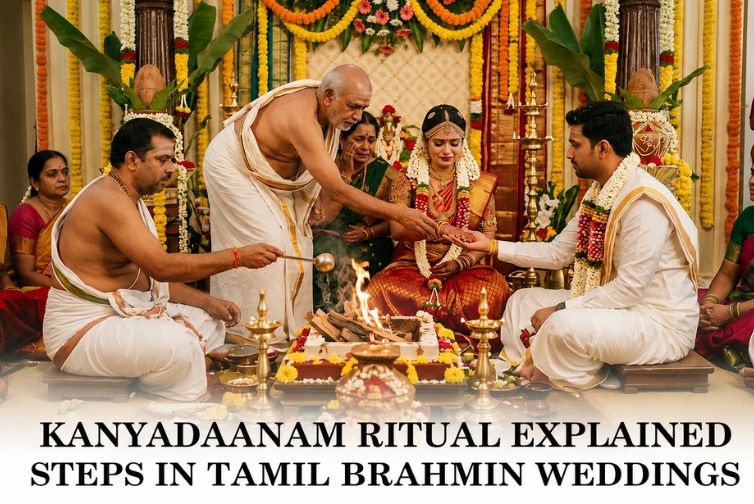
A brahmin wedding moves through many rituals across a single day. Some are celebratory, some are elaborate, and some bring the room to a full stop. Kanyadaanam is the last kind. Families booking marriage halls in Kovilambakkam for Brahmin weddings tend to ask about this ritual early, because it determines how they want the mandapam stage arranged and how much time the priest needs to prepare.
The word is Sanskrit. “Kanya” is a daughter, “daanam” is offering. The father formally gives his daughter to the groom in front of fire, family, and a priest who guides every line. The ritual itself lasts around twenty minutes. Families remember it for the rest of their lives.
What Kanyadaanam Actually Means
Vedic tradition places kanyadaanam above most other forms of giving. The reasoning is straightforward: a father offering his daughter with genuine intention and a clear conscience earns merit that carries forward through generations. That belief shapes how the ritual is performed. Nobody drifts through it.
In any brahmin wedding, this is the moment where two families formally become one. The priest guides the father through a declaration that names his own lineage, his daughter’s identity, and his clear intention to give her willingly. The groom responds with his own chants, accepting responsibility for her well-being across every phase of life.
How It Begins at the Mandapam
The bride is brought to the stage and seated beside the groom. The priest opens with mantras to call on ancestral blessings. The bride’s hands are placed over the groom’s, and the father places his hands on top of both.
Sacred water is poured over the joined hands during kanyadaanam. Betel leaves and raw rice are placed on top. This part of the brahmin wedding takes only a few minutes, but the image of three sets of hands together is something most guests carry with them long after the day ends.
The Sankalp: The Father’s Declaration
The Sankalp is a formal spoken statement. The father recites his full family lineage, the bride’s name, and his intention to give her in marriage. The priest leads each line. The father repeats it.
What separates this part of kanyadaanam from other rituals is its specificity. It is not a general blessing. The father publicly names exactly what he is doing and why. There is no room for vagueness in it.
The Mother’s Role
Tamil brahmin wedding tradition places the father in the formal speaking role during kanyadaanam. The mother is not a passive presence though. She holds the conch shell, helps with the water pouring, and places her hand alongside her husband’s at specific moments.
Her participation is treated as essential even without being announced. Both parents are giving their daughter. The ritual just gives them different actions.
Gifts and the End of the Ritual
After the Sankalp and the groom’s response, gifts are exchanged between the two families. They carry more meaning than their material value suggests. They are a signal of respect between two households that are now bound to each other.
Kanyadaanam closes here. The brahmin wedding continues with Sapthapadi, Mangalya Dharanam, and other ceremonies, each one building on what was just committed to. But ask most families and they will tell you that kanyadaanam is when the wedding stopped feeling like an event and started feeling like a beginning.
How the Venue Affects the Ritual
A stage that is too small or poorly lit loses half the ritual for guests sitting beyond the first few rows. A priest who has to wait on logistics loses the rhythm he has built across hours of ceremony. These things matter during kanyadaanam more than at any other point.
VRTM hosts brahmin wedding ceremonies regularly. Our stage is wide enough for the full seating these rituals need, and every part of the hall is set up so guests can follow what is happening. We have seen how much a well-organized space changes the experience for families and we take that seriously.
Planning the Whole Day
A brahmin wedding runs long. Guests come from different neighborhoods, sometimes different cities. Our Kalyana Mandapam in Chennai has 24 fully equipped rooms for families who need to stay close, centralized air conditioning, and a dining area that seats 400 at a time. We are on Medavakkam Main Road in Kovilambakkam, easy to reach from most parts of Chennai. If you are planning a brahmin wedding and want a venue that handles the details so your family can focus on the rituals, get in touch with us.
Meta desc: The Kanyadaanam ritual explained, every step of this sacred Tamil Brahmin wedding ceremony and why the right venue makes all the difference.
